When the summer heat rolls into the Chicago area, most homeowners go straight for the thermostat. But running your AC on full blast all summer isn’t cheap. ComEd’s residential electricity rate hit 10.4 cents per kWh as of June 2026, and cooling alone can account for 10 to 15 percent of your monthly electric bill during peak summer months. The good news is there’s a smarter way to stay comfortable without watching your energy bill climb every week.
The answer isn’t choosing between a ceiling fan and your AC. It’s knowing how to use both.
At a Glance:
- Ceiling fans don’t lower the room temperature; they create a wind chill effect that makes you feel cooler.
- Running a ceiling fan lets you raise your thermostat by 4°F with no loss in comfort, according to the U.S. Department of Energy.
- Ceiling fans use 97 to 99 percent less electricity than central air conditioners.
- In summer, your ceiling fan should spin counterclockwise to push air downward.
- Professional installation makes sure your fan is safely wired, properly mounted, and actually working the way it should.
Ceiling Fans and AC Do Different Things
A ceiling fan doesn’t cool the air in a room. It cools you. The moving air creates a wind chill effect that speeds up evaporation on your skin, making you feel several degrees cooler than the actual room temperature. The moment you leave the room, the fan isn’t doing anything useful.
Air conditioning works the opposite way. It actively removes heat and humidity from the air, so the whole room gets cooler regardless of whether anyone’s in it. That’s why AC is the only real option when humidity is high, and temperatures climb into the 90s across the North Shore. A fan alone won’t cut it.
Can a ceiling fan replace my air conditioner in summer?
In mild weather, maybe. But in Illinois summers, with heat indexes that regularly push past 95°F, a ceiling fan works best as a supplement to your AC, not a replacement.
The Case for Ceiling Fans: Energy Savings Are Real
Central air conditioners draw between 2,000 and 5,000 watts during operation. A ceiling fan typically uses between 13 and 100 watts. That’s 97 to 99 percent less electricity, and the difference shows up on your bill.
Running a ceiling fan in an occupied room lets you raise your thermostat by about 4°F with no reduction in comfort, according to the U.S. Department of Energy. Set it to 74°F instead of 70°F, run the fan, and your AC runs less without your home feeling any warmer. Every degree you raise your thermostat reduces cooling costs by roughly 3 to 5 percent. Over a Chicagoland summer, that adds up.
One thing to keep in mind: turn the fan off when you leave the room. Ceiling fans cool people, not spaces. Leaving one running in an empty room just wastes electricity.
Get the Direction Right
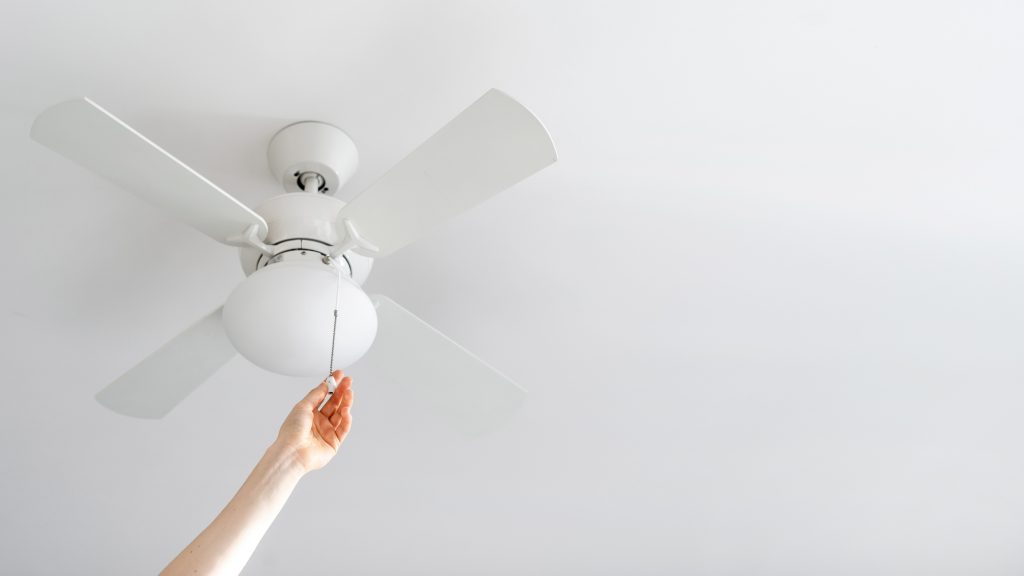
In summer, your ceiling fan should run counterclockwise. That rotation pushes air straight down, creating the downdraft that produces the wind chill effect. Most fans have a direction switch on the motor housing. If you’re standing under the fan and don’t feel any airflow, flip it.
Run your fan on medium to high in summer to maximize airflow. Save the low setting for winter, when you’ll reverse to clockwise to gently circulate warm air without creating a draft.
How do I know if my ceiling fan is spinning the right way?
Stand underneath it and look up. If the blades are moving counterclockwise and you feel air pushing down toward you, it’s set correctly. If you don’t feel anything, flip the direction switch.
Choosing the Right Fan for Each Room
The U.S. Department of Energy recommends a 36 or 44-inch fan for rooms up to 225 square feet. For larger rooms, go with 52 inches or more. In rooms longer than 18 feet, two fans will outperform one oversized model.
Fans should hang at least 7 feet above the floor. In rooms with standard 8-foot ceilings, a flush-mount fan is the right call. Higher ceilings may need a downrod extension to bring the fan low enough to move air at the living level.
If you’re adding a fan where there’s only a light fixture or no overhead fixture at all, that’s where professional ceiling fan installation comes in.

Why Professional Installation Is Worth It
A standard light fixture box isn’t built to support a ceiling fan. Fans are heavier than light fixtures and move constantly, which puts ongoing stress on the mounting point. Installing a fan on a non-rated box is a real safety risk. Improper wiring can cause shorts or fires, and a poorly mounted fan can come loose.
A licensed electrician installs a fan-rated box, confirms the wiring is code-compliant, and makes sure the fan is balanced and secured. If the room doesn’t have existing wiring, a professional can run a new dedicated circuit from your electrical panel.
Most standard ceiling fan installations take about an hour. That’s a small investment for a fixture you’ll run every day all summer.
Stay Cool Smarter This Summer
Ceiling fans and AC aren’t competing. They’re a team. Keep your thermostat a few degrees higher than usual, run ceiling fans in occupied rooms, and let your AC handle the heavy lifting on the hottest days. With utility rates where they are, that approach makes a real difference by the end of the season.
If you’re thinking about adding ceiling fans or replacing old ones, the Nu-Trend team handles the installation and any wiring upgrades your home needs. We serve homeowners across Schaumburg, Naperville, Barrington, Elk Grove Village, Buffalo Grove, Palatine, Northbrook, and the surrounding North Chicago suburbs.
FAQs: Ceiling Fan VS. AC
Q: How much can I save by using ceiling fans with my AC?
A: Raising your thermostat by 4°F, which the DOE says is comfortable with a ceiling fan running, reduces cooling costs by roughly 12 to 20 percent. Over a full Chicago summer, that’s a meaningful difference on your ComEd bill.
Q: Do I need an electrician to install a ceiling fan?
A: If you’re replacing an existing ceiling fan, a confident DIYer can sometimes handle it. But if you’re installing where there’s a light fixture or no overhead fixture, you need a licensed electrician. Standard light fixture boxes aren’t rated to support the weight and movement of a ceiling fan, and incorrect wiring is a genuine safety hazard.
Q: What size ceiling fan do I need for my room?
A: For rooms up to 225 square feet, a 36 or 44-inch fan works well. Larger rooms need 52 inches or more. In rooms over 18 feet long, two fans will circulate air more effectively than one large model. A licensed electrician can help you choose the right size and placement for each room.
Schedule Your Ceiling Fan Installation With Nu-Trend Electrical Today
Call us at (847) 882-1888 or contact us online to get on the calendar. Our licensed electricians have 15+ years of experience and will get the job done safely and correctly the first time.